FusionCloud™ is the interpretation layer of ONETest™: transforming microbial sequence data into ranked, interpretable outputs for organism relevance, AMR-marker context, and interpretation support.
Beyond detection, Fusion AI applies organism-specific dynamic ML thresholds calibrated using validation and control data, turning genomic signal into structured reporting that can support laboratory review and clinical-context interpretation.
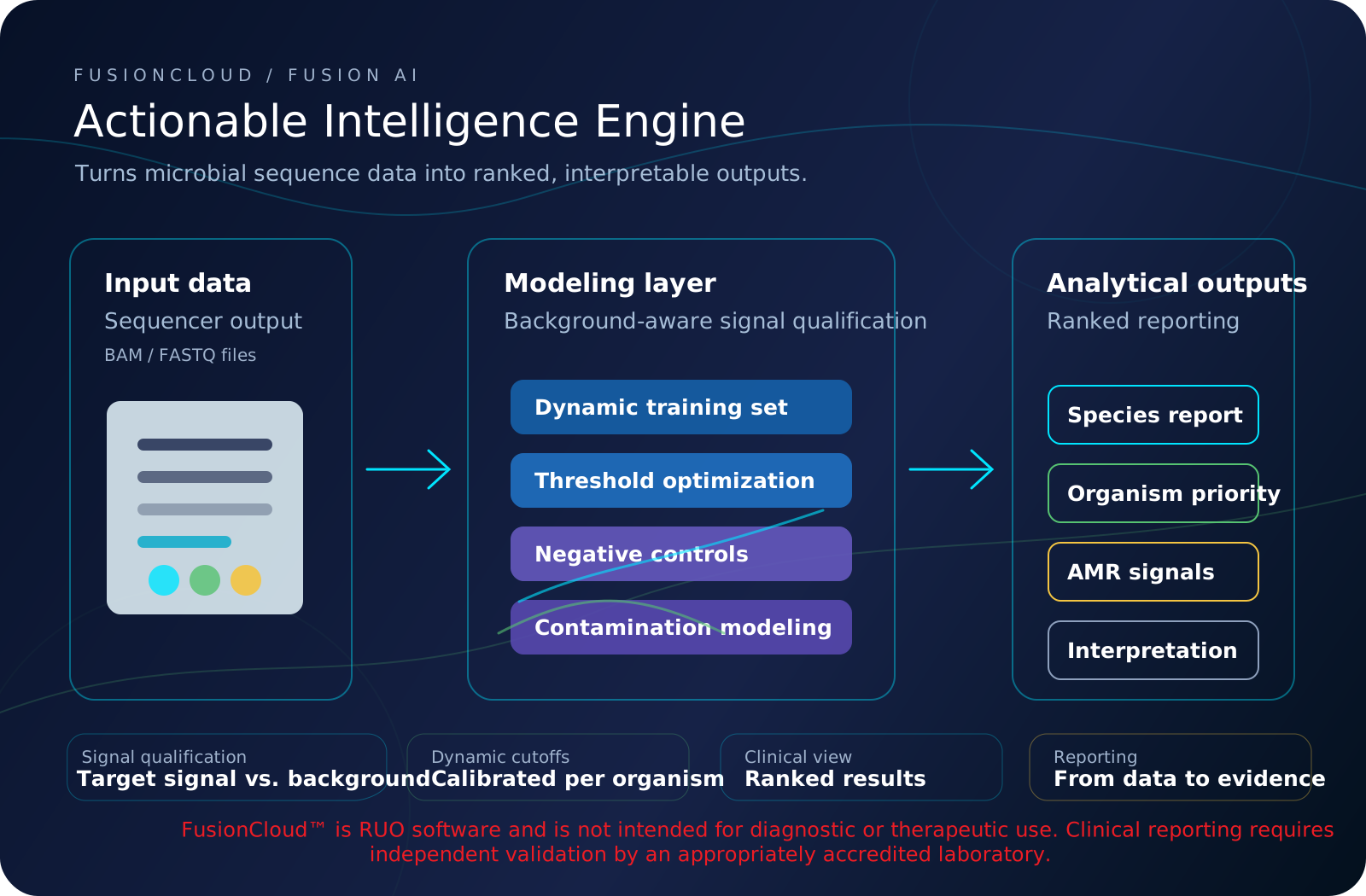
Clinical metagenomics can generate many microbial signals from pathogens, colonizers, normal flora, environmental background, and reagent contamination. FusionCloud™ is designed to convert that complexity into a structured evidence layer for laboratory review and clinician interpretation.
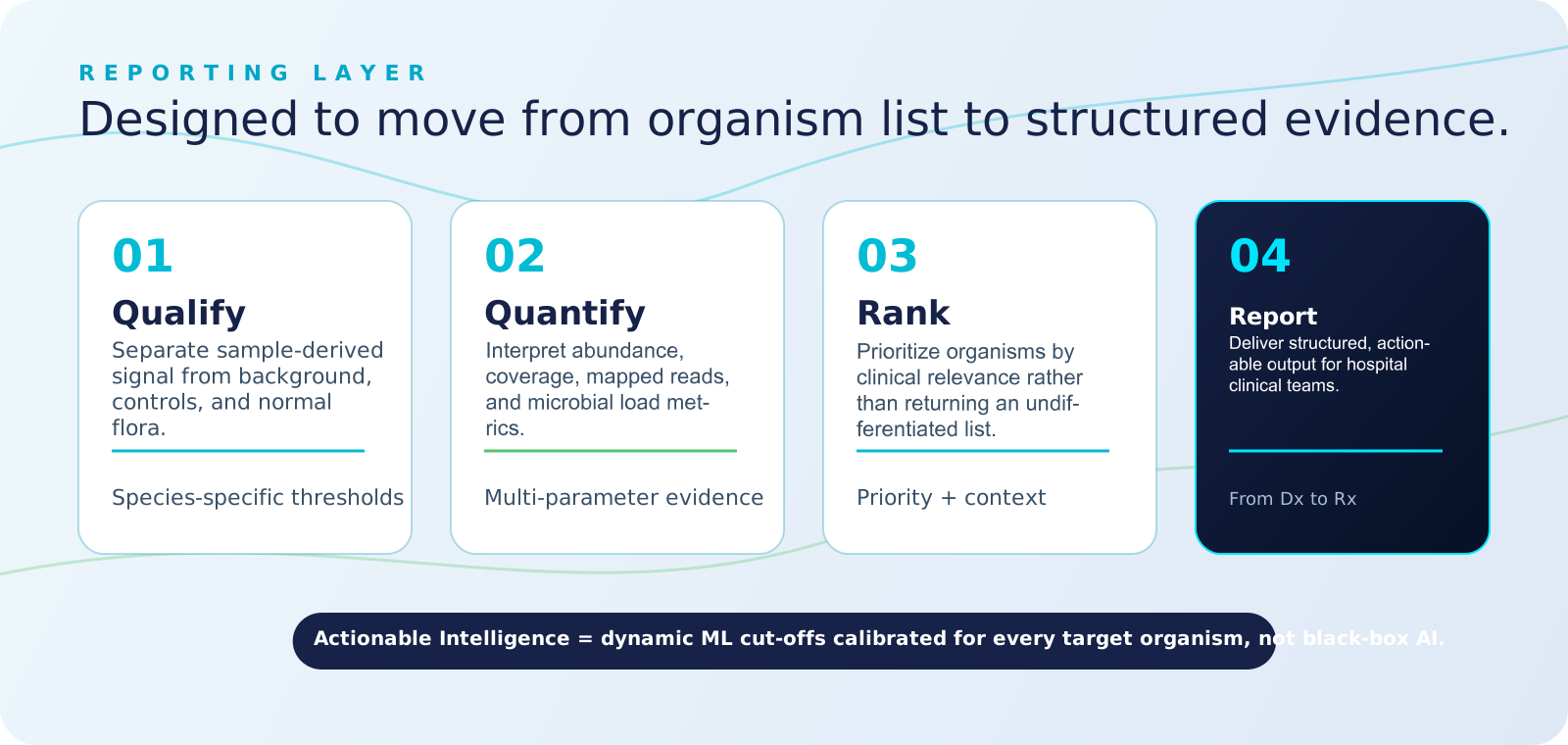
Control-aware filtering distinguishes sample-derived microbial evidence from background, contaminants, and normal flora.
Organism-specific baselines and dynamic thresholds support detection rules that are not one-size-fits-all.
FusionCloud™ organizes results around organism prioritization, AMR-marker context, and interpretation support and not an undifferentiated organism list.
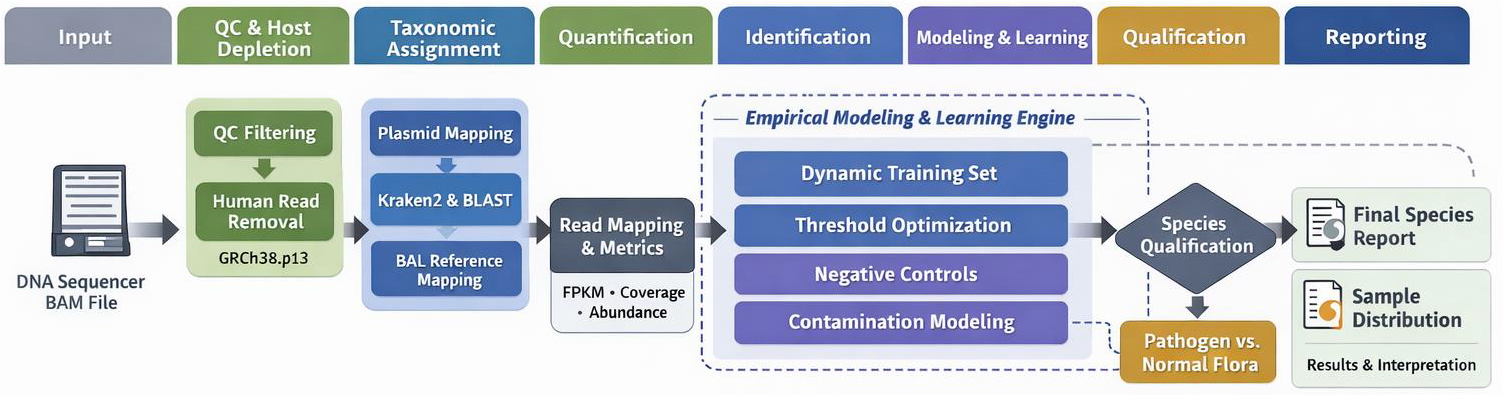
FusionCloud™ connects bioinformatics, empirical modeling, negative-control learning, contamination modeling, species qualification, and structured reporting into one analysis pipeline.
DNA sequencer file enters the cloud workflow.
Quality filtering and host-read handling.
Reference mapping and organism calls.
FPKM, coverage, abundance, and mapping metrics.
Training sets, thresholds, controls, and contamination models.
Pathogen vs. normal flora and background classification.
Structured species output, sample distribution, and interpretation support.
FusionCloud™ uses empirical thresholds and multi-parameter evidence to determine whether a microbial signal should be qualified, categorized, and surfaced for review. This is the software layer that turns targeted metagenomics into laboratory-reviewable workflow.
The engine is built around interpretable evidence: mapped reads, abundance, coverage, species-specific background distributions, controls, and structured output categories.
Thresholds are calibrated against observed background distributions rather than applying one universal cutoff across all organisms.
Run controls and historical control behavior help identify recurrent reagent, sequencing, and process-associated background.
FPKM, relative abundance, breadth of coverage, mapped reads, and other metrics are combined to support a qualified result.
Final outputs are organized to support laboratory review, clinical-context interpretation, antimicrobial-stewardship review, and follow-up testing considerations.
FusionCloud™ is designed to make reports useful in the critical-care window: which organisms are detected, which signals are prioritized, what AMR-marker evidence is available, and what evidence should be reviewed in context.
The FusionCloud™ model reflects the realities of lower-respiratory specimens: host-rich samples, commensal flora, antibiotic exposure, polymicrobial findings, and organism-specific background behavior.
Used in the clinical cohort to model background signatures.
Helped define recurring species-level background patterns.
Micro-averaged across culture-benchmarked BAL organisms.
Additional microbiologic findings beyond routine culture in the BAL cohort.
FusionCloud™ is built to support contamination-aware interpretation: OT-positive / culture-negative signals are treated as additional microbiologic findings that should be interpreted alongside abundance, controls, specimen type, antibiotic exposure, and orthogonal evidence where available.
Qualified signal with support from organism-specific thresholds and metrics.
Contextual classification for organisms commonly present in respiratory specimens.
Signals suppressed or downgraded based on control-informed background behavior.
ONETest™ combines QuantumProbes™ capture, UniPrep™ chemistry, fluidics automation, and FusionCloud™ analytics. FusionCloud™ is where raw genomic signal becomes structured analytical evidence.
QuantumProbes™ enrich microbial DNA.
UniPrep™ converts DNA into a sequenceable library.
Fluidics workflow reduces manual complexity.
FusionCloud™ ranks organism evidence and AMR-marker context.
FusionCloud™ closes the gap between sequence data and interpretation by transforming complex microbial signals into ranked, analytical outputs for organism relevance, AMR-marker context, and interpretation support.